Curiosity Traps
On reverse honeypots, rewarding close attention, and finding your people
In computing, honeypots attract bad actors into interacting with a system.
As usual, this principle can be reversed. You can deliberately put out some kind of intellectual honey that will attract good actors instead, and lead to joyful serendipity.
If you wear a shirt that says, “Dyslexics are teople poo”, that attracts one kind of conversation; a CERN standard model tee attracts another (in my case: “what’s it mean?”, “dunno”, the end.). The examples are endless – trail race swag attracts conversations with fellow trail runners; wearing something handmade gets the attention of other crafters – but conversations started by conversation pieces aren’t usually that deep or well-targeted.
Conversation pieces are decent at starting conversations, but we don’t see that many people face-to-face (well, I don’t!), so there’s a limit to how specific you can make the reference, and still meet people who get it.
Henrik Karlsson (are you tired of me referencing Henrik Karlsson yet?) articulated the idea that a blog, or any public collection of work, is a way of passively collecting a network of interesting people that are unusually well-matched with your interests, without having to go to hundreds of speed-networking events in a nerdy tee shirt.
 Henrik Karlsson
This seems true. I’ve met a lot of interesting people by putting things out on the internet. But this, like most worthwhile things, can be fractal.
First you go in public, then you wear a conversation piece, then you leave “handles” and “doorknobs” in your answers to the basic questions, creating a choose-your-own adventure for your conversation partner.
First you make stuff, then you put it on the internet. If you stop here, you’re missing out! That’s like going out in public – with airpods in, and staring at the ground. The next step is to put lots of links to your contact form or email, and explicitly ask for feedback, and make it easy for people to say hello.
Each post is a hook for a different conversation, with a different kind of person. Each post has a chance of pushing a reader over the activation energy threshold to start a conversation. Posts are, also, cumulative. Someone might read for years, and then write in to discuss draining pasta without a colander.
(Other people might subscribe, and then realize, oh, that’s not actually an $X blog, it’s a kitchen sink blog, and I’m only interested in 1/10th of the things they write about. Bye! If you have to pay to send emails, this is actually a good thing. They can still read your posts about $X when they bubble up in the $X communities they hang out in.)
But within a blog, you can also place Easter eggs that target sub-segments of your readers.
[ SPOILERS FOR WAITBUTWHY READERS AHEAD ]
I’m old enough to remember the turtle in Wait Buy Why’s footer, which went to a page that said “You clicked the turtle”. This is a classic curiosity trap. The people who end up on that page are a small segment of their most engaged and curious readers.
I don’t see the turtle in the footer anymore. Only today did I discover that it’s turtles all the way down. The turtle page has a turtle that goes to another page, that has a smaller turtle that goes to another page that claims “You Win” but actually has a tiny turtle that goes to I actually can’t believe you, which has a giraffe that goes to Tim Urban’s old blog. Maybe it also has a pico-turtle that I missed.
This was probably gave me the idea for using the interrobang as the icon for my /intractable page. And the whole idea of the intractable page is that it’s an entire box of doorknobs. Whether or not they found it via the tiny interrobang in the footer, nifty people have written in as a result of that page, and I consider it a success.
I’d like to cook up a game that writers and anyone else can play, of burying things in their work that only the most attentive people will notice, as a way of incentivizing that kind of close attention.
Then I thought, wait, that game has already been invented! It’s called life.
This is also, generally, how art works. (Adam Mastroianni has a great post about art that rewards close attention.)
But even if the universe already works this way, and art already works this way, we can turn up the gain, and create a subsubgame within the subgame within the game, where the rules and rewards are made more clear and immediate.
Wait But Why gives one simple example: a treasure hunt with the first clue hidden. Footnotes are another.[1] For anything put in public, there is a distribution of how deeply people engage with it. For public art: ignore, glance over, stop and look, go over and look, climb/look-up-on-the-internet/copy/vandalize/destroy.[2]
One of the tricky things about creating layered art is how to make it work on all levels. (Henrik thinks this isn’t necessary; I somewhat disagree.) If you put the heavy math in the main text, mathphobes stop reading. Basically, everyone is looking for an excuse to stop reading, so the more tangents and puzzles you include, the fewer people make it to the end. [3] Different people have different goals about how widely they want to appeal, and how many people they are willing to drive off, in order to engage their ideal readers.
Footnotes[4], inside jokes that
don’t
disrupt
the flow
of reading,
and links to explainers of unfamiliar concepts are all ways of catering to different audiences in the same piece, the same way that cafés offer both dine-in and takeout.
An obvious example is text holding invisible significance. Cyphers are fun, but they tend to be fun in the same way that picking very small berries is fun. It’s fun at first, but only as a novelty, because the payoff doesn’t justify the effort. They often feel like a tangent.

I spent two days before I thought I found it, and felt ripped off.
While we're at it, an obnoxious fortune cookie riddle: "What goes up a drain pipe down, but not down a drain pipe up?" I have been mulling this one over for more than a year. I come up with countless answers that satisfy the constraint (hot air, helium, bubbles, ivy, "pipe down!"), but none of the are the official correct answer.
Many famous people make it possible, but difficult, to find their contact info 🔒. This is another example of rewarding the most engaged readers. And tech companies often put their job postings in the sourcecode, or print them to the browser console, as a way of filtering candidates. [5]
Another problem with the whole concept of curiosity traps is that sometimes the people who engage most deeply are obsessed weirdos, rather than people with unusually aligned interests. This is more a problem for people who are famous personalities. In my experience, the people who write in to obscure blogs tend to be unusual in a good way.
Easter Eggs and gimmicks are fun, and worth including. But after trying to write an article about these artificial curiosity traps, I have realized that the best curiosity traps emerge naturally. If you write from concrete experience, and you publish a lot, people will notice the details. Because I was once a designer, every time I go to a website made by a designer, even if the layout is very plain, there’s something hard to place, but recognizably designed, that I appreciate. This applies everywhere: we notice when other people care about the things we care about. And when we notice that someone else cares about very similar things[6], it’s feels like meeting a friend we haven’t met yet.
You clicked the footnote! You are special. Now we are stuck in here together. If my footnote script supported nested footnotes, we could keep going all day! [7] ↩︎
Most public art disappoints me, but the pretzeled balsa rubber band aeroplane in Stanley Park – er, I mean, cough Aerodynamic Forms in Space cough — has always tickled me.[8] ↩︎
Case study: someone who is fairly close to my ideal reader read a draft of this essay. He pointed out design flaws with my blog, typos, and “unfinished thoughts”, and generally engaged deeply with the text[10] (even opening the devtools to inspect the footnote implementation), yet missed every single easter egg, and concluded that the last paragraph was his favourite, because:
I don’t really engage with the internet as a social… as a way of meeting people. I mostly engage in other ways that are mostly fairly mercantile: to learn or disseminate knowledge, in an urgent way.
This is a valuable reader who I would like to keep, even if they miss all my curiosity traps, so it’s important to make the traps subtle enough that they don’t slow down and irritate readers of this type, who aren’t interested in solving silly puzzles, and just want to get to the point, if there is one. ↩︎I mostly use footnotes like this: 1) move the weakest and most digressive parts to footnotes, then 2) realize they aren’t needed, and 3) delete the footnotes. This one got missed. ↩︎
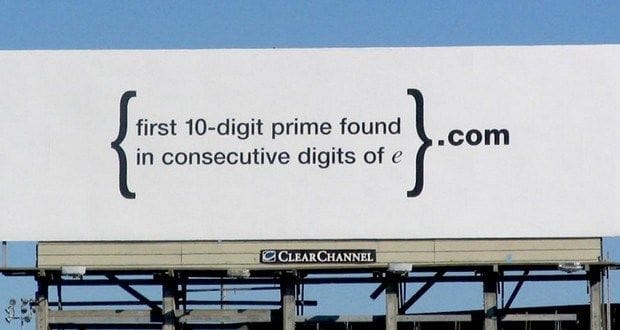
Google is famous for their billboard problem:
 . ↩︎
. ↩︎A recent example: https://stevekrouse.com/readme ↩︎
https://dn721608.ca.archive.org/0/items/a-night-at-the-opera-1935-HD/A Night at the Opera.mp4#t=250,285 ↩︎
I am sorry that I spoiled both of these in the post about how I figured out how to deeplink :( [9] ↩︎
Okay, if you're here you are very special, having figured out that I deliberately left my nested footnotes broken so you would have to view source or use reader mode. (In my markdown file, this footnote has the id #final-boss.) You have also probably the kind of person who would definitely click on "Don't click this link!". Also, by now you may agree with me that puzzles and cyphers, without an adequate payoff, are an annoying tangent. ↩︎
The same reader recommended the subtitle "honeypot for pooh bear". Does this not throw doubt on everything else he said? Unless, of course, it was a test to make sure I wasn't shunting the brain and blindly following all his suggestions. ↩︎