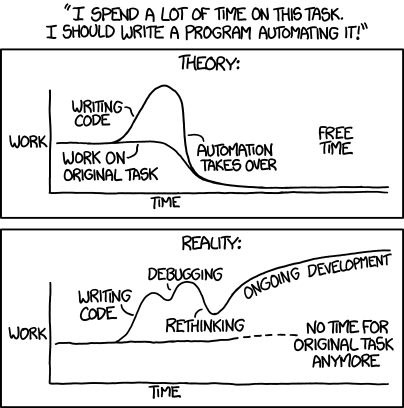
Intelligence* — as far as I can tell — is a variable, not a constant. It fluctuates, the same way a healthy person’s heart-rate varies over time. Graph it, and it looks like this:
…
»
Elon Musk is planning to colonize Mars. If he succeeds, it could be one of the most important changes in human history. And, based on the surprising success of his previous ventures — including
…
»
In this tutorial I’ll show how to convert manuscripts written in markdown into a variety of industry-standard formats, automatically, using Pandoc.
Why bother?
I write short-stories and essays in markdown, but many
…
»
Ghost is a free, open-source, and beautiful piece of software that allows you to write and publish your own blog — while keeping out of the way.
Heroku is a Platform as a Service
…
»
A year ago we released EEGrunt and wrote an announcement post here on The Autodidacts, which included a brief overview of what EEGrunt was good for and a quick getting-started tutorial.
EEGrunt is
…
»
Mark Twain said, “there comes a time in every rightly constructed boy’s life when he has a raging desire to go somewhere and dig for hidden treasure.” As the youngest brother of
…
»
If you’ve read previous articles on this blog, you know that we have a hankering for amateur neuroscience and have been doing some EEG experiments with the OpenBCI.
At first, we used
…
»
Today we’re delighted to launch our latest project into the world. After months of development, we present NeuroBB — The EEG, BCI, and Neurofeedback Discussion Forum.
Brain-computer interfaces have evolved to the point
…
»
The OpenBCI Processing application supports basic filtering and configuration, but options for manipulating the data further are scarce. When my OpenBCI arrived, I started looking around at the other software options.
Python and
…
»
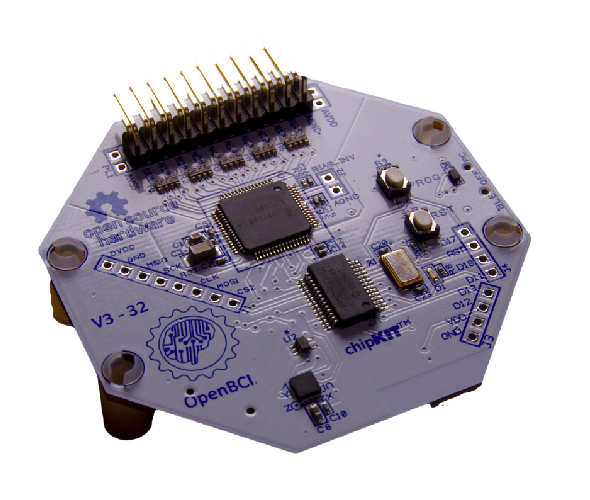
In October, I pre-ordered an OpenBCI, billed as the open-source brain-computer interface for makers. It arrived a few days ago, and after some technical hurdles, I’ve completed my initial tests.
What follows
…
»
In this article I’m going to introduce the regions of the brain, the scientific terms for location, and the lobes that produce EEG signals that can be measured with a non-invasive device
…
»
Understanding a little bit about what we know of the brain and how it works is a necessary step for anyone interested in brain-computer interfaces, EEG, or biofeedback. This article is an overview
…
»
A few years ago I was given an Emotiv EPOC headset. The EPOC is a reasonably affordable, consumer EEG headset with 14 channels — essentially, a device that measures electrical activity generated inside the
…
»
The button has finally been pressed. After months of waiting—and saving up—my pre-order for an OpenBCI board has been placed.
The OpenBCI is an open-hardware, open-software ‘Brain Computer Interface’ capable of
…
»